
Ropes- Vital to the Maritime Industry
This blog post was motivated by such a mundane topic as rope after reading an article in Preservation in Print by S. Frederick Starr about the longest building in New Orleans, a building that no longer exists but at one time was an active center for rope making in the city. Being a sailor, I am aware of the importance of rope to the recreational and commercial maritime communities now and the historic past. Why is the longest building related to rope? It served as a manufacturing center for rope production that required a “rope walk” to twist the fibers used to produce rope in great lengths. Before addressing details about the building and its purpose, let’s investigate rope- its uses, history, materials, and the rope making process.
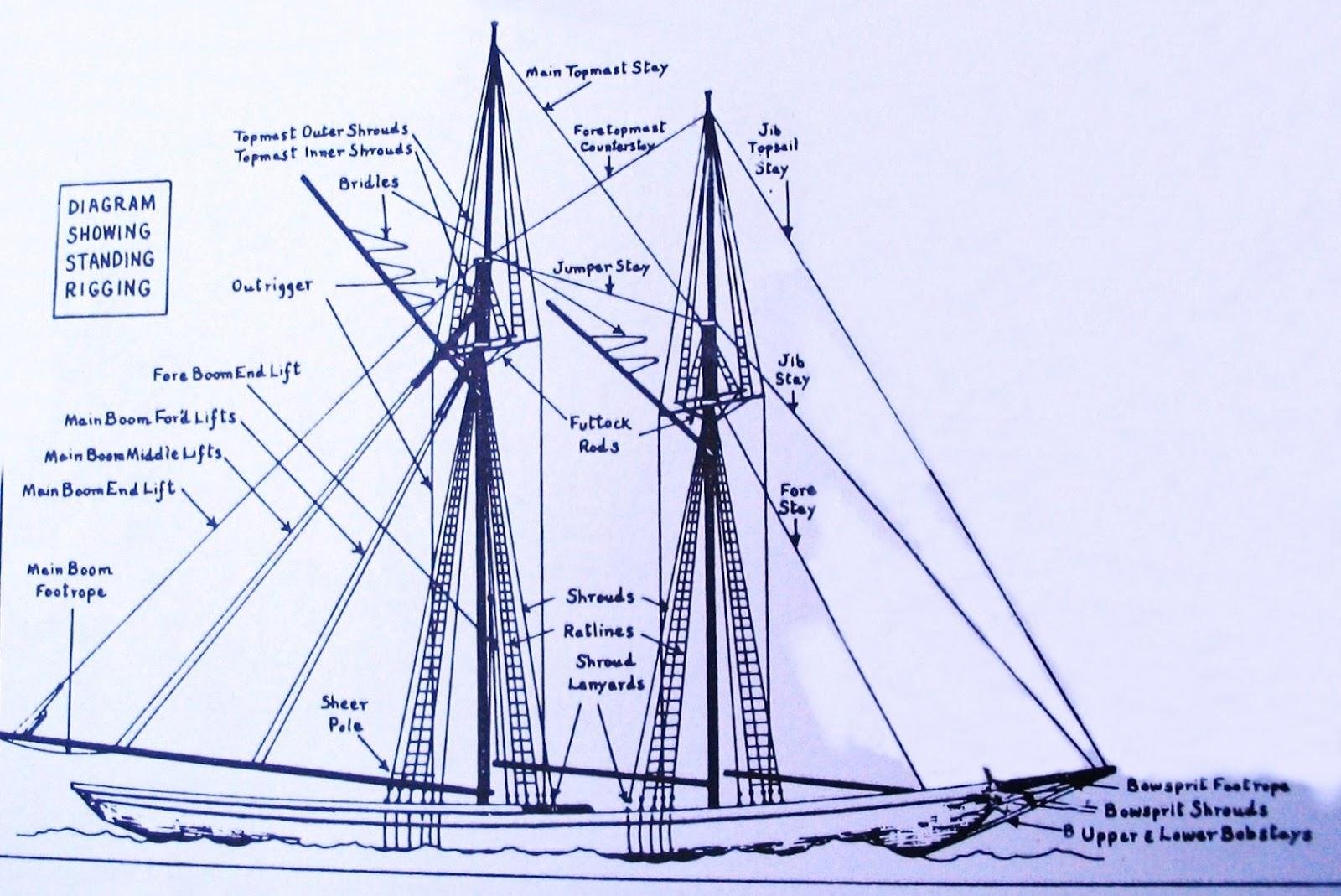
Throughout the age of sailing and beyond, rope has been a critical if not mandatory commodity. As early sailing vessels were devised and built, rope was needed for the running and standing rigging. By standing rigging is meant the ropes
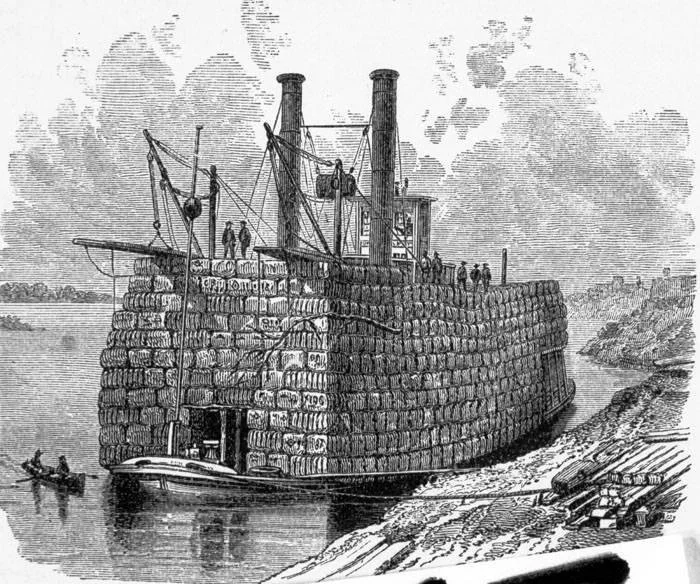
or cables that secure the spars of a sailing vessels particularly the masts that were stayed athwartship, fore, and aft for stability. The collection of ropes to control the trim of the sails or their orientation to the direction of the wind, makeup the running rigging. Still other uses of rope on sailing vessels and later on steamships include for handling and securing cargo, for dock mooring, and for anchoring. The etching illustrates an extreme example of the use of ropes to secure cotton bales to a stern paddle steamboat. Tow boats currently use ropes to link barges to the tow boat and other barges. In some instances, vessels and barges are towed using rope.
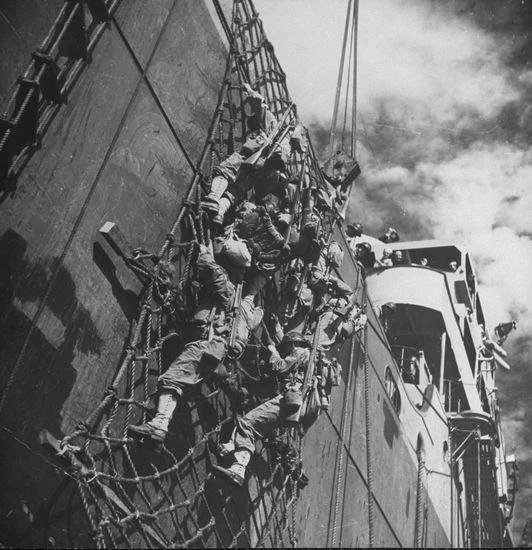
The need for and use of ropes were also vital to the D-Day Invasion at Normandy in 1945. Rope ladders strung from the sides of troop ships allowed soldiers to disembark from the ship into the waiting landing craft to storm the beaches of Normandy. In advance of the beach assault, using ropes tied to powered aircraft, gliders were towed across the English Channel to land behind enemy lines.
Modern sailing vessels, particularly those used for recreational purposes, still use ropes (now termed lines on recreational sailboats) for running rigging- halyards to raise and lower sails and sheets to trim sails. As in the past, rope is still used for mooring and anchoring purposes. Rope standing rigging has been replaced with wire cable. Many knots have been devised to tie ropes together and to tie ropes to objects and connectors. In combination with pulleys, ropes can be used to devise block and tackle systems with a significant mechanical advantage.
It should be recognized that the term rope is a generic term applicable to a variety of different materials and manufacturing processes. Depending on those factors, ropes can have different strengths, different stiffnesses, and different durability’s. Let’s first examine the materials, both natural and manmade, used to produce rope. By definition: “A rope is a group of yarns, plies, fibres, or strands that are twisted or braided together into a larger and stronger form.” (Wikipedia)
As listed in Wikipedia, common natural fibers used for rope production are Manila hemp, hemp, linen, cotton, coir, jute, straw, and sisal. Synthetic fibers in use for rope- makinginclude polypropylene, nylon, polyesters (e.g. PET, LCP, Vectran), polyethylene (e.g. Dyneema and Spectra), Aramids (e.g. Twaron, Technora and Kevlar) and acrylics (e.g. Dralon)
Evidence of rope making has been found to exist as many as 50,000 years ago. A tool discovered in a cave in southwestern Germany, dated 35,000-40,000 years ago, was identified to be for rope making purposes. The ancient Egyptians are generally recognized as the first civilization (4000-3500 BC) to develop special tolls to make rope. They principally produced ropes using water hemp fibers.
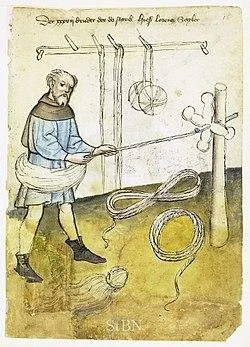
Beginning in the Middles Ages and extending into the 18th century, ropes were produced in ropewalks that were very long buildings that would allow full length strands of the material to be used to produce the rope were spread out and “then laid up or twisted together to form the rope.” The cable length or maximum length of the rope was dictated by the length of the available ropewalk. Using this process, ropes as long as 300 yards were produced. Here is an artist’s depiction of an English ropemaker at work (c.1425).
Ropes longer in length would require splices to link two sections of rope together. According to Wikipedia (Rope splicing - Wikipedia):
Rope splicing in ropework is the forming of a semi-permanent joint between two ropes or two parts of the same rope by partly untwisting and then interweaving their strands. Splices can be used to form a stopper at the end of a line, to form a loop or an eye in a rope, or for joining two ropes together. Splices are preferred to knotted rope, since while a knot typically reduces the strength by 20–40%, a splice is capable of attaining a rope's full strength.[3] However, splicing usually results in a thickening of the line and, if subsequently
removed, leaves a distortion of the rope. Most types of splices are used on three-strand rope, but some can be done on 12-strand or greater single-braided rope, as well as most double braids. There are various types of splices, each to serve a somewhat different purpose.
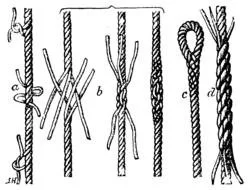
Examples of splices in different stages of completion, from the Nordisk familjebok: a) long splice b) tapered short splice c) eye splice d) short splice
Given this background on the history, production, and uses of rope, particularly in the maritime sector, let’s examine the production of rope in New Orleans and the building in which it was produced.
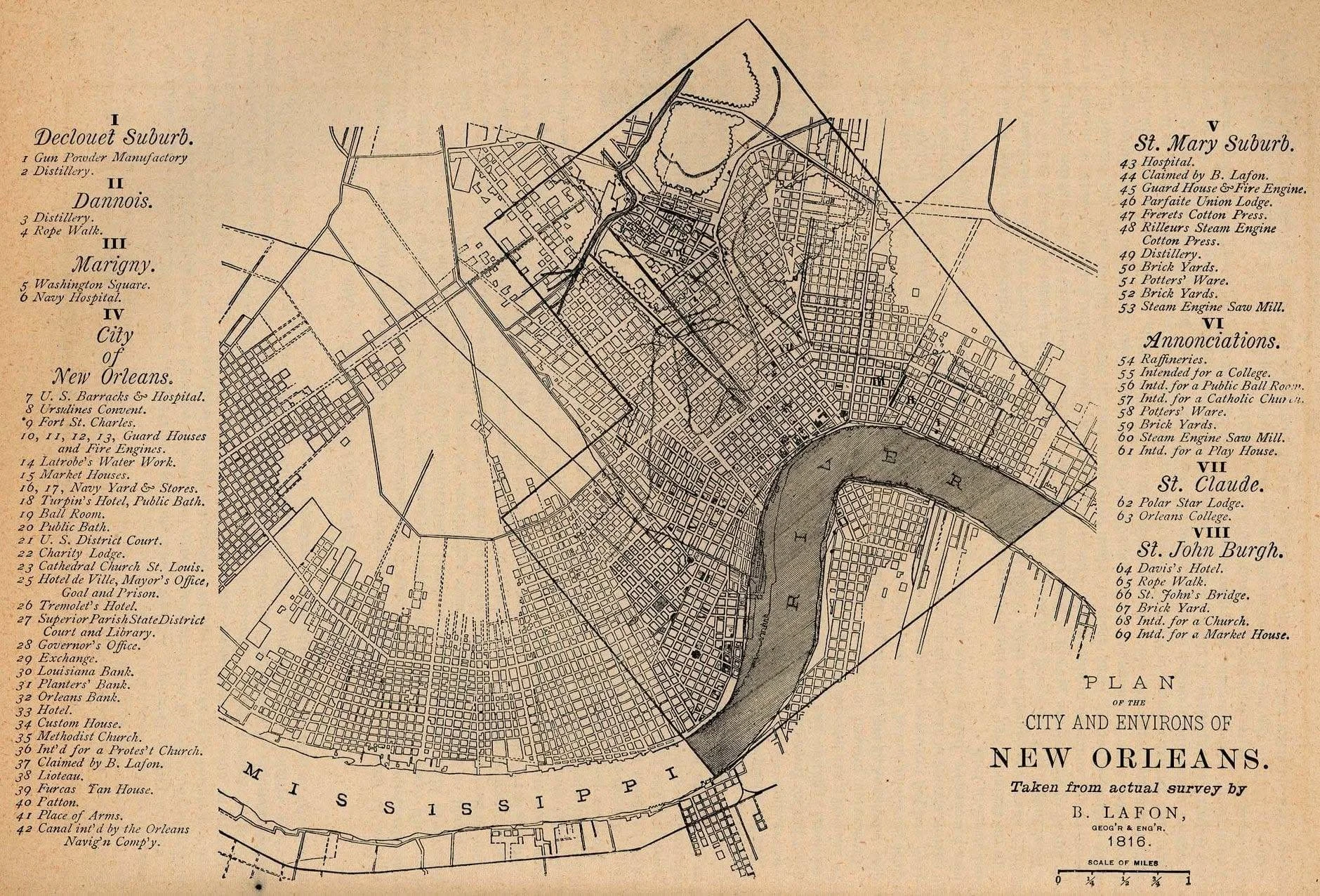
In his article, Starr noted that B. Lafon’s 1816 plan of New Orleans identified two rope walks among the industrial sites. Both Rope Walks are depicted graphically on the map as being approximately four blocks long. Considering the number of sailing vessels visiting the port of New Orleans starting in the late 18th century and extending into the 19th century, it is not surprising that rope production and rope production facilities were an important part of the city’s industrial infrastructure. Given the need and the opportunity, one set of entrepreneurs constructed a rope walk in an undeveloped area that is now Marigny. One of the buildings, simply termed the Rope Walk, extended from near the river at Spain and St. Ferdinand Streets and based on the Lafon’s map, stretched inland for approximately four blocks. Given that typical length of a block in New Orleans at that time, as it is today, was 600 ft, this specific Rope Walk was approximately 2500 ft in length, just a little less than one half of a mile. The inland Rope Walk was also depicted on Lafon’s map as being approximately 4 blocks in length.
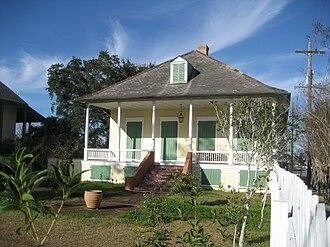
The exact year production was initiated at either of the Rope Walks is unknown but likely around the turn of the 19th century. Starr reported that each Rope Walk likely employed to more than 100 men. The principal raw material for the production of rope was hemp. A material that could easily be produced at local farms and plantations. According to Starr, one of the major producers of hemp was the Lombard Plantation located in what is now the Bywater Area, making the distance between the farming of hemp and the production of rope at Marigny comparatively short. The hemp grown was termed industrial hemp to distinguish it from smokable hemp.
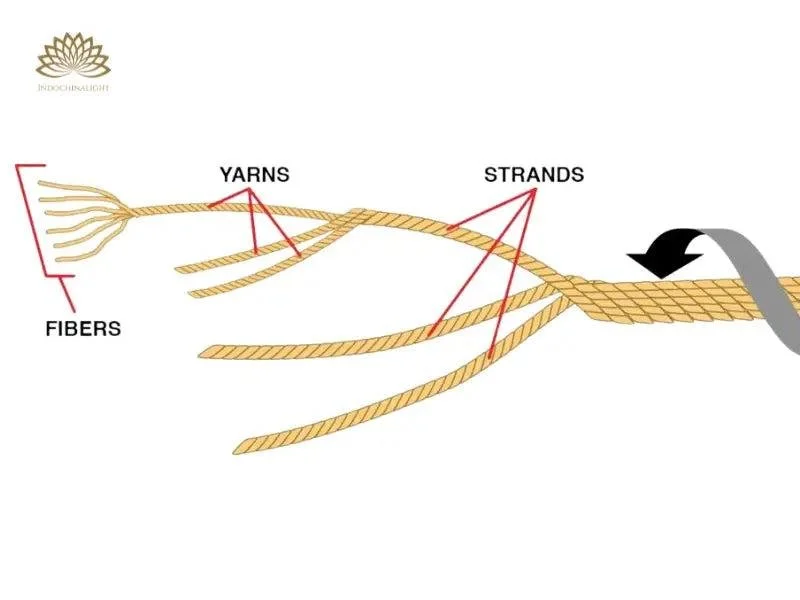
Early rope making was a five-step process primarily dependent on manpower (https://indochinalight.com/blogs/pendant-lights/what-is-hemp-rope):
Step 1: Harvesting & Retting Hemp Plants- Results in separating the fibers cleanly. Responsibility of the farmer.
Step 2: Cleaning Plant Matter- A process to produce clean fibers free of plant materials and ready to be spun into yarns.
I’m not sure if Step 2 was the responsibility of the farmer or the rope maker. However, the remaining processes were definitely the role of the rope maker.
Step 3: Spinning Yarns- The clean fibers are then fed through spinning machines (or spun by hand) to create thin, consistent yarns.
Step 4: Twisting Cords- The yarns are twisted together to form larger strands.
Step 5: Rope Forming- Multiple twisted strands are secured at one end and then twisted together at the other end using a forming machine.
Starr noted that the Rope Walks thrived during the early third of the 19th century but by 1832 the Rope Walk in the Marigny area had closed, and the building torn down. He attributed the closure of that particular Rope Walk to the failure of the owners to make the transition from manpower to steam power in their rope making process. Starr did speculate that the owner or owners of the Rope Walk might have died from either yellow fever or cholera during the epidemic of 1832. Starr offered no insights into the fate of the inland Rope Walk. Whereas the use and need for rope by principally the steamboat industry would still have existed, it’s quite possible that the Rope Walk made the transition to steam power and its owners survived the epidemic. More in-depth research is needed to answer these questions.
Sources
Starr, B. Frederick. New Orleans’ Longest Building, Preservation in Print, Preservation Resource Center of New Orleans, August/September 2026.
Rope Making. https://indochinalight.com/blogs/pendant-lights/what-is-hemp-rope
Rope. https://en.wikipedia.org/wiki/Rope
Rope Splicing. https://en.wikipedia.org/wiki/Rope_splicing
