This brief history of Liberty ships would not be complete without an accounting of the fate of all the Liberty ships and their crews during and subsequent to their service during WWII as well as a more detailed summary of the activities and workers at the Delta Shipyard in New Orleans. These topics will be the basis of the Part B brief.
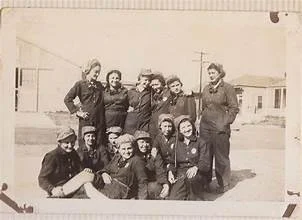
Let’s begin by taking a look at the Delta Shipbuilding Company workforce building Liberty ships for the WWII effort. In raw numbers, the workforce totaled as many as 16,000 men and women. Unfortunately, I have not been able to determine the actual distribution of men and women. Within that total was an undeterminable number of minority workers. Although minority worker numbers were initially limited by segregation policies and quotas, labor shortages ultimately forced management to relax segregation policies and quotas to provide greater work opportunities for minority workers. In spite of this relaxation, minority workers were still underrepresented in the Delta workforce.
The need for workers went beyond numbers. Production of the ships required skilled welders, electricians, plumbers, and machinists, among others. One such training program was provided by the National Defense School on Frenchman Street. This particularly school was tasked with training women for welding and burning. Training programs were also provided by the National Youth Administration (NYA) and specialized schools among which was the Issac Delgado Central Trades School (now known as Delgado Community College). At the same time
the various schools were training workers for Delta Shipbuilding, they were also training workers for the Higgins. The welding school at the National Defense School encompassed 200+ hours of hands-on training in welding and burning. Other skills training courses involved intensive, multi-week sessions over a 2-month period. As you might expect, some of the training was provided through on-the-job training. Obviously, the need was to prepare job-ready workers as fast as possible. Note that the required combined workforce for Delta and Higgins was approximately 36,000, so the workforce training challenges were enormous.
The working conditions for employees of Delta Shipbuilding were somewhat dangerous resulting in workplace injuries. There were also long-term health risks from asbestos exposure. Production demands also required around-the-clock shifts- presumably three 8-hour shifts, 7 days a week. It’s interesting to note the variation in the rate of production of Liberty ships by Delta Shipbuilding starting in October 1941 and extending to July 1945. Rate of production of Liberty ships by year is as follows: 1942- 28; 1943- 60; 1944- 67; and 1945- 34.
The first six ships produced required from 186-242 days. Subsequently, no ship required more than 144 days for completion. Here is a summary of the distribution of required days of production:
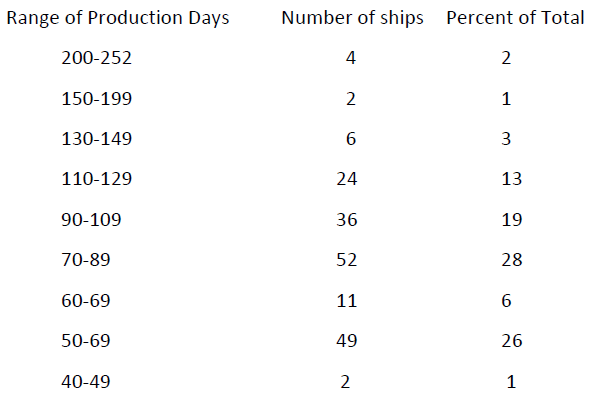
Completion rates at the beginning of production undoubtably suffered from inexperienced workers and possibly time needed for assembling tools, materials, parts, and supplies. During the course of production, adverse weather conditions could have delayed fabrication.
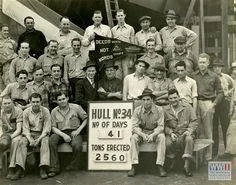
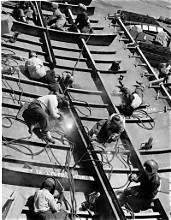
Near the end of the production period in 1945, the yard was producing EC2-S-AW1 Collier (coal transport) ships. The first such ship required a fabrication period of 178 days. Subsequently, the fabrication periods improved and generally ranged from 100-140 days. The photo to the left shows the production crew that completed a conventional Liberty ship in the ways in 41 days. Completion of the ship required another 17 days in the water. The photo to the right shows female welders working on the hull of a ship.
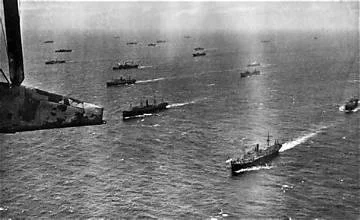
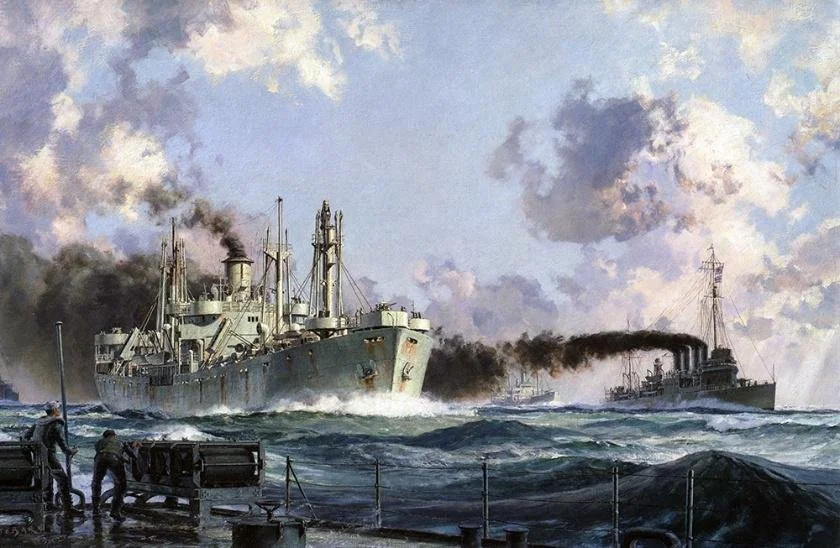
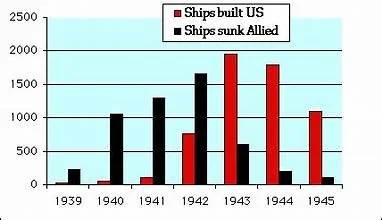
The importance of Liberty ships for the allied WWII effort cannot be overstated. It is estimated that Liberty ships carried approximately 75% of the materials and supplies used by the U.S. armed forces during the war. In transporting supplies and later troops, the Liberty ships sailed in convoys escorted by U.S. Navy destroyers. The principal dangers to the ships were the German U-boats operating in the North Atlantic and the Mediterranean Sea and German-laid mines. German U-boat dominance gradually diminished during the war as Allied detection technology and weaponry improved so that by mid-1943, their losses were outweighing their dominance. The sheer numbers of Liberty ships and cargo vessels seemed to overwhelm the capability of German forces to stem the relentless tide of convoys and their escorts. In the Pacific, Liberty ships were vulnerable to Japanese kamikaze attacks. Crews of Liberty ships faced two additional dangers- the welding practices, stress concentrations at hatches, and brittle steel used resulted in catastrophic hull failures and detonation of cargoes of volatile munitions during handling and attacks.
Once placed into service, what were the fates of these ships and their crews in both the Atlantic and Pacific theaters of war? Before addressing that question, let’s review the manner in which the ships were manned. During WWII, Liberty ships normally carried a total complement of 60-100 crew members and officers. The crew members and officers included
civilian merchant mariners who ran the ship and U.S. Navy Armed Guard personnel who operated the defensive deck guns.
The civilian personnel were divided into four departments- deck, engine, stewards, and specialists. Deck personnel under the direction of the ship’s captain steered the ship and operated the cargo booms. The chief engineer managed the engine and the boilers. Lead by the chief steward, meals were provided for all ship personnel. Specialists included radio operators, pursers, and typists.
The naval personnel were under the command of a junior naval officer- Lieutenant JG or Ensign. His role was to train gunners and signalmen and have overall responsibility for the safety of the ship to the extent that was possible. Liberty ships were vulnerable to U-boat attacks in the North Atlantic and enemy aircraft attacks in both the Atlantic and the Pacific.
Although there was some variation from ship to ship, each ship was normally equipped with a gun at the stern and bow and multiple anti-aircraft autocannons spaced across the deck. The deck guns normally consisted of a 4-in/50 caliber naval gun mounted on a raised platform on the stern and a 3-in/50 caliber naval gun mounted on the bow. The anti-aircraft guns were normally 20 mm Oerlikon cannons. Up to eight single or twin autocannons were placed on raised platforms across the superstructure. The gun crews consisted of up to 40 U.S. Navy Armed Guard personnel. Some key areas such as the gun locations and the ship’s bridge were protected with lightweight armor.
Using the Delta Shipbuilding complement as a representative sampling of the fate of Liberty ships during WWII, it’s possible to assess how the ships fared in the light of dangers posed by enemy forces. Out of the 188 Liberty ships produced by Delta Shipbuilding, nine were torpedoed and sunk; two were torpedoed but survived, repaired and returned to service; one was reported to have exploded; two were mined; one was wrecked after hitting a U-boat; and one broke up and sunk. The comparatively small percentage of either sinkings or damage (8.5%) among the Delta Shipbuilding Liberty ships does not necessarily provide insight into the possible human toll on the crews of the ships. Potentially, as many as 1600 individuals could have been impacted- killed or injured. Even if crew members survived an attack, exposure to the frigid waters of the Atlantic or the Pacific could have caused their deaths due to exposure.
It is estimated that 1 out of every 26 Liberty ship mariners died in service. One source concluded that “Out of the roughly 200,000 mariners, 6,795 lost their lives-giving them a
higher casualty (death) percentage (3.4 %) than some branches of the military.” By contrast, the death rate among Marines in WWII was 3.35 %. Of course, neither rate accounts for the injuries, some catastrophic, sustained by both the mariners (civilian and military) and the Marines.
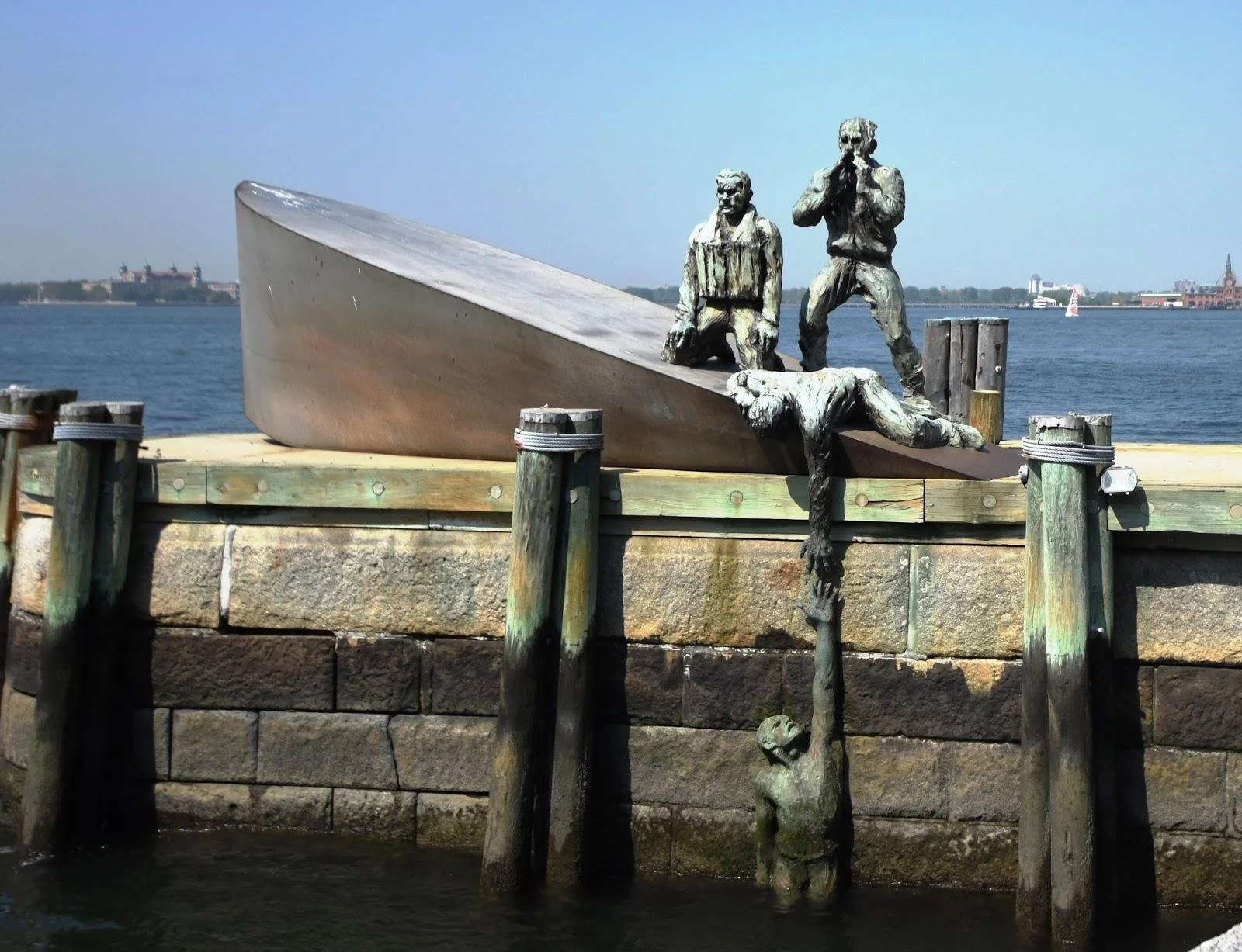
In recognition of their service and sacrifice, merchant marines have been honored and memorialized by a number of monuments around the country. Perhaps the most meaningful and haunting memorial is located in Battery Park, New York City. According to https://www.atlasobscura.com/places/the-american-merchant-mariner-s-memorial-new-york-new-york:
“Hidden away in the water off Battery Park is one of the most moving memorials you are ever likely to see. The American Merchant Mariner's memorial, sculpted by Marisol Escobar in 1991, takes the form of three merchant seamen stranded on a sinking ship, terrified, calling for help and trying to reach the desperate hand of one of their shipmates floundering in the water below.”
The sculpture bears the following inscription: "This memorial serves as a marker for America's merchant mariners resting in the unmarked ocean depths." The monument is based on a true
event, the sinking of SS Muskogee by German U-boat 123 on March 22nd, 1942. The Muskogee was sailing from Venezuela to Halifax carrying a cargo of petroleum. Without an escort and unarmed, the Muskogee was hit by a torpedo in her engine room and began to sink within a quarter of an hour, 335 miles north-northeast. Ten survivors clung to life rafts in the burning sea as the U-boat surfaced. The submarine captain Reinhard Hardegen took their photograph, and it's from this, that Escobar based her sculpture.”
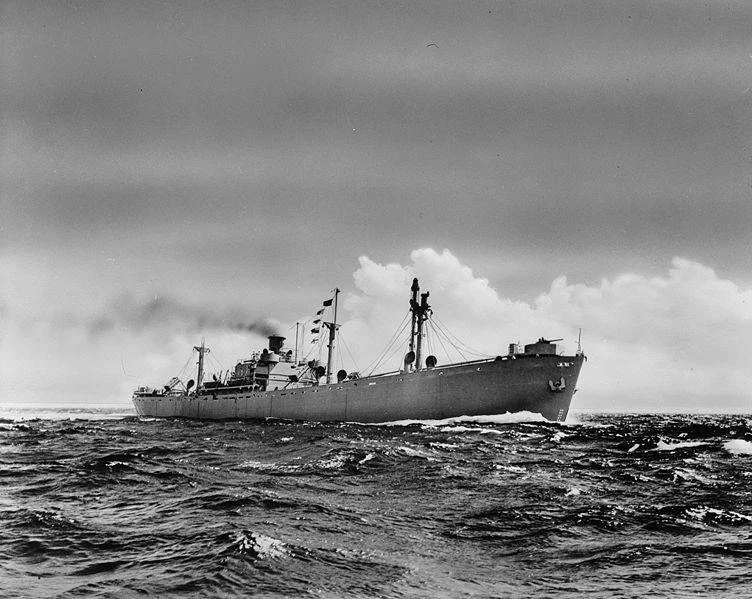
In closing, I hope that this brief will bring to the attention of its readers of the service and sacrifices of the merchant marine officers and crews that steered their Liberty ships through hostile waters and the U.S. Navy Armed Guard personnel who did their best to protect the ships during WWII. Their contributions to the WWII effort cannot and should not be underestimated or forgotten. We should also not forget the contributions of thousands of male and female workers who toiled daily under difficult conditions over a period of four years to build Liberty ships.
Sources
Liberty Ship- https://en.wikipedia.org/wiki/Liberty_ship
Liberty Ships: The Unsung Heroes of WWII- https://www.historytools.org/stories/the-liberty-ships-unsung-heroes-of-world-war-ii
What were the Liberty ships and how did they help to win the war- https://www.historyhit.com/what-were-the-liberty-ships-and-how-did-they-help-win-the-second-world-war/
World War II: Battle of the Atlantic/ Cargo Ships https://www.history.navy.mil/content/history/museums/nmusn/explore/photography/wwii/wwii-atlantic/battle-of-the-atlantic/merchant-ships/liberty.html
World War II: The Liberty Ship Program- https://www.thoughtco.com/the-liberty-ship-program-2361030
