Two earlier briefs detailed the contributions of the Higgins Boat Company to the country’s WWII efforts through the development and construction of principally landing crafts but to a lesser extent PT boats, and coastal freighters. Over a period of 5 years, the company produced a total of over 21,000 vessels (20,000 landing craft, 300 PT boats and 900 varied ships, barges, and boats for the Army) and employed in excess of 20,000 workers. Truly a monumental effort and accomplishment.
Much lesser known are the contributions of the Delta Shipbuilding Company to the war effort by the production of the less exciting but nevertheless important freighters termed Liberty Ships. As noted in an article that appeared in Sea History, Spring 2026, these ships were dubbed “ugly ducklings” by President Roosevelt in 1941. The author of the Sea History article, Ross Patterson II, a curator at the World War II Museum, concluded that “these ubiquitous steam vessels emerged from shipyards across the United States, forming the world’s largest-ever ship class and providing the logistical backbone to win a global war.”
The nation-wide effort to build Liberty Ships, basically ocean-going freighters was initiated on January 3, 1941, by President Roosevelt’s announcement of the establishment of the Emergency Shipbuilding Program. The initial target was to construct 200 ships similar to those being built Todd Shipyards for the British. The program was to be administered by the Maritime Commission, a department established in 1937 to direct “merchant marine development.” The question is- why was an American shipyard building ships for the British? Before the United States entered WWII on December 7, 1941, the British and their allies were alone in the fight against Nazi Germany. German submarines patrolled and largely controlled the seas in the Battle of the Atlantic resulting in ships of the British Merchant Fleet being sunk at a faster rate than they could be replaced by shipyards in the United Kingdom. In an attempt to address this issue, Sir Arthur Sister led a group of men called the British Merchant Shipping Mission to enlist U. S. and Canadian shipbuilders to construct merchant ships. However, at the time, all active shipyards capable of constructing ocean-going merchant ships were either building ships for the U. S. Navy or the U.S. Maritime Commission’s Long Range Shipbuilding Program. The latter program had begun earlier to fulfill the goals of the Merchant Marine Act of 1936.
Not to be deterred, the British mission, in collaboration with the U. S. Maritime Commission, negotiated with a consortium of companies including the Todd Shipyards and the Bath Iron Works among others. As an outcome of these negotiations, the Todd-Bath Iron Shipbuilding Corporation was formed and established a new shipbuilding yard adjacent to Cummings Point in South Portland, Maine. This corporation was contracted to build 30 cargo ships. A second corporation, called the Todd-California Shipbuilding Corporation, was formed in the Western U. S. involving Todd Shipyards and several heavy construction companies to build 30 identical ships. The new yard was located on the tidal flats of Richmond adjacent to San Francisco Bay.
On December 20, 1940, the contracts for both yards and the ships were signed. The ships were collectively termed the Ocean Class and were of British design. The cargo ships were to have 5 hatches, a displacement of about 10,000 tons and 11 knots service velocity. Chosen for the power plant was what was termed an “obsolete but readily available” triple expansion, reciprocating steam engine and coal-fired Scotch-type fire tube boilers. The first vessel, Ocean Vanguard, was launched from the Todd-California yard on October 15, 1941, less than 300 days after signing of the contract.
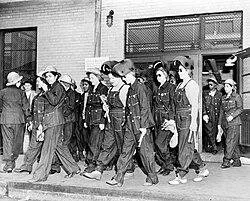
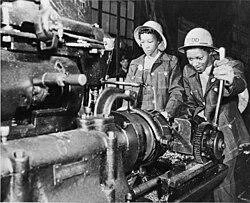
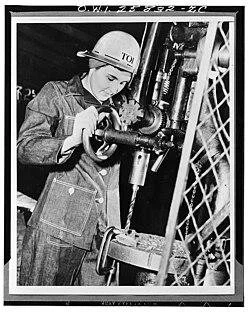
These photos depict female workers at one of the Todd Shipyards. The left-hand photo is of female welders on the way to their jobs in 1943.
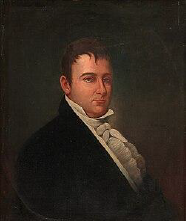
William C. C. Claiborne
Starting in 1941, the Delta Ship Building Company, managed by the American Shipbuilding Company of Ohio, was contracted to start building Liberty Ships corresponding to the initiation of the Emergency Shipbuilding Program referred to earlier. The Delta Shipyard was established on the Industrial Canal just south of the present day I-10 bridge. Originally configured with 6 ways, it was later expanded to 8 ways. The U. S. Maritime Commission provided $13M for the development of this facility. The keel for the first ship (MC 120) constructed at this site was laid October 1, 1941. Named the William C. C. Claiborne after the man who had served as both the Governor of the Territory of Orleans and the first governor of the State on Louisiana, the ship was launched on March 28, 1942, and delivered on May 31, 1942, having been 178 days in the ways and 64 days in the water. A photograph of the launching can be found at https://www.ww2online.org/image/launching-ss-william-cc-claiborne-new-orleans-1942 The Claiborne had a service life of 19 years and was scrapped in 1961.
The first of all the Liberty Ships produced, the SS Patrick Henry, was launched on September 22, 1941, at the Bethlehem Shipyard in Baltimore, Maryland.
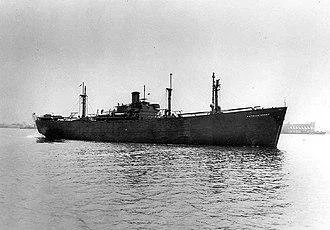
SS Patrick Henry
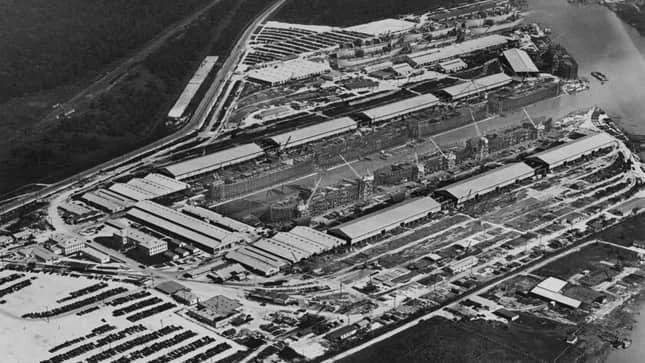
This photo provides an aerial view of the Delta shipyard on the Industrial Canal. At the time of the photo, it appears that there are seven ships at various stages of completion.
Delta was just one of nine emergency shipyards that participated in the program. During the active period of this program a total of 2710 ships were produced. In advance of formally initiating the production of the Liberty Ships based on the British-designed Ocean vessels, the design was modified by the U. S. Maritime Commission for the following reasons: to increase conformity with American construction practices and to make it quicker and cheaper to build. The ships were designated in the following manner: EC2-S-C1 (EC for emergency cargo; 2 for a length between 400 and 450 ft; S for steam engines; and C1 for design C1). A total of 2,580 vessels of this design were produced. There were four variations of this design (number in parentheses indicates the total number of a given design that was produced):
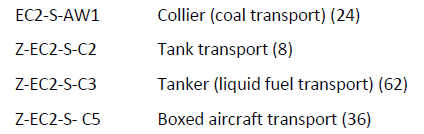
The Delta Ship Building Company in New Orleans produced a total of 188 vessels of the following design and number:
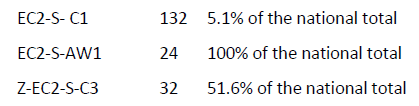
Other Gulf Coast ship building yards producing Liberty Ships included:
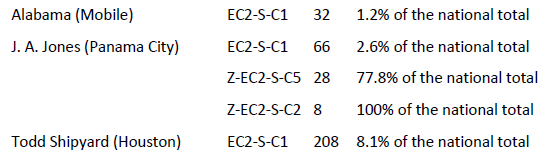
Collectively, the Gulf Coast, Atlantic, and West Coast shipyards produced the following percentages of the various types of Liberty Ships (Gulf Coast/Total):


No rationale was found concerning the types of vessels produced at a given yard. However, it is evident that the Gulf Coast shipyards were largely responsible for the production of the non-standard (i.e., ships other than the EC2-S-C1 design) Liberty Ships.
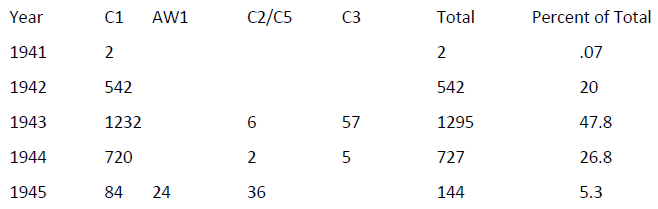
Nationally, Liberty Ship production was initiated in late 1941 and continued to the end of WWII in 1945. Production reached its peak in 1943 as the following data indicate:
In the production of Liberty Ships, much of the riveting was replaced by welding which resulted in a considerable cost and time savings and used oil-fired rather than coal-fired boilers. A large percentage of the welder workforce was women who proved to be as good if not better than male welders. The ships were designed to carry 10,000 long tons. For power, whereas more advanced engines were available at the time, “a 140-short-ton (130 t)[14] vertical triple expansion steam engine, of obsolete design, was selected to power Liberty ships because it was cheaper and easier to build in the numbers required.” Like the British Ocean vessels, this engine would propel the Liberty Ship at a normal operating speed of 11 knots (13 mph).
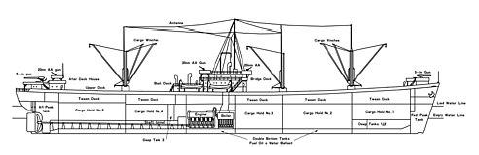
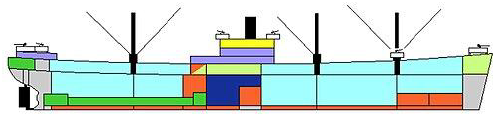
Referring to the colored diagram, the utilization of space in a C1 Liberty Ship was as follows:
Machinery- Green
Command and control- Yellow
Liquid stores- Red
Dry cargo- Light Blue
Engine Room- Dark Blue
Dry Stores- Aqua
At latest count, the following Liberty Ships remain:
SS John W. Brown- Operational and serving as a museum ship. Baltimore Harbor
SS Jermiah O’Brien- Operational and serving as a museum ship, Pier 35, San Francisco
SS Arthur M. Huddell- Transferred to Greece in 2008; renamed Hellas Liberty; Maritime Museum, Piraeus Harbor
SS Albert M. Boe- Sold for private company, serves as headquarters for Trident Seafood, Kodiak, AK
This brief history of Liberty ships would not be complete without an accounting of the fate of all the Liberty ships and their crews during and subsequent to their service during WWII as well as a more detailed summary of the activities and workers at the Delta Shipyard in New Orleans. These topics will be the basis of the Part B brief.
Sources
Wikipedia- Liberty Ships-https://search.yahoo.com/search?fr=mcafee&type=E211US105G0&p=Liberty+ships
Patterson II, Ross. National World War II Museum, Sea History, National Maritime Historical Society, The Lane Press, South Burlington, Vermont, Spring 2026.
http://shipbuildinghistory.com/shipyards/emergencylarge/delta.htm
Bourneuf, Jr., Gus. Workhorse of the Fleet, American Bureau of Shipping, Spring, Tx, 1990.
