Captain Octavius Howe and his Clipper Ship Reporter
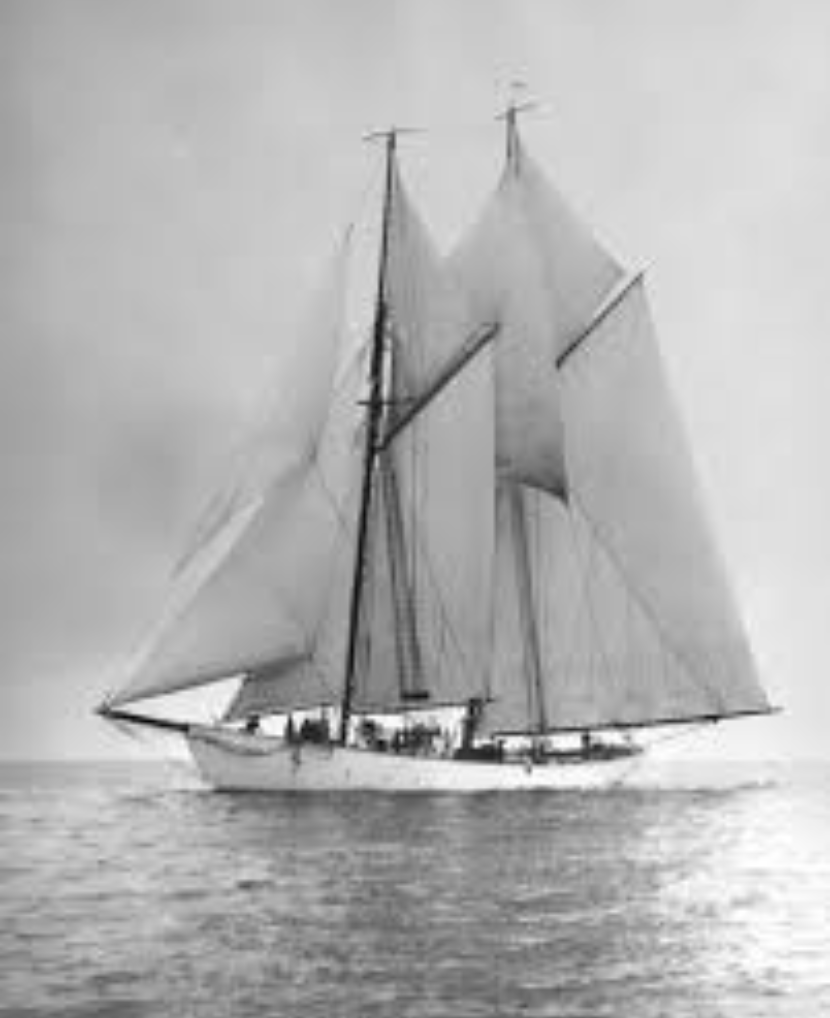
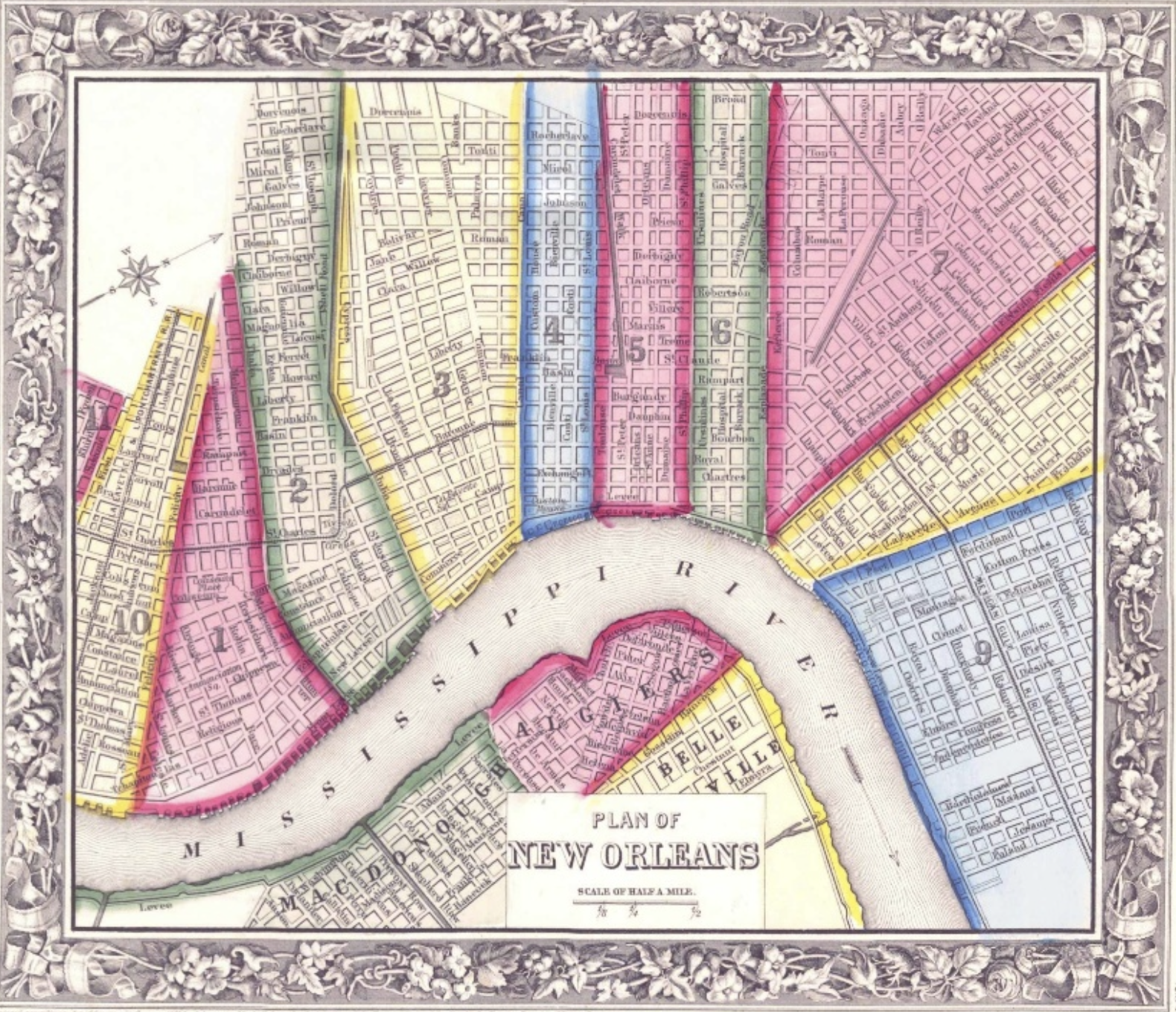
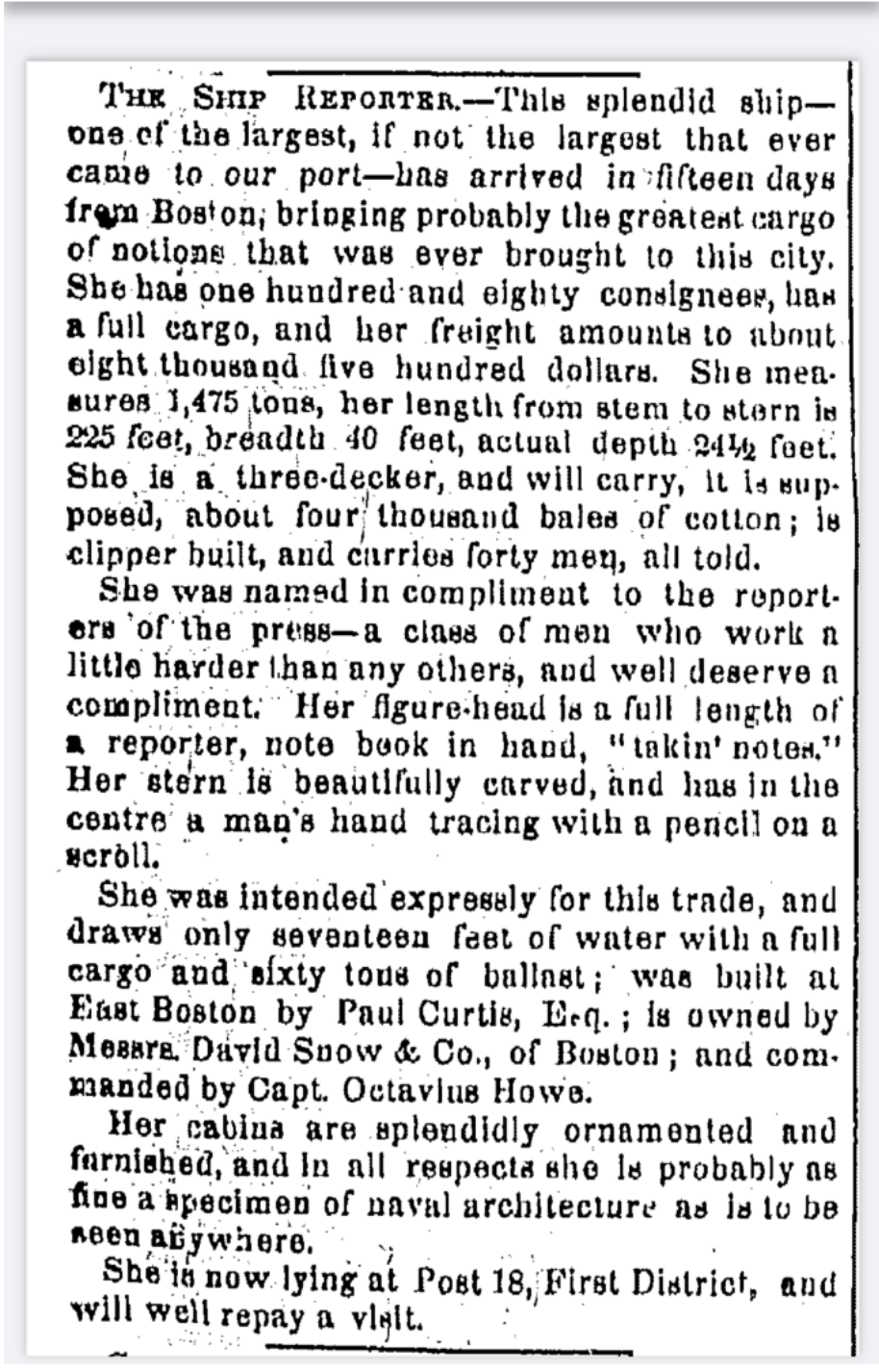
In October of 1853, under the command of Captain Octavius Howe, the clipper ship Reporter struggled over the bar at Southwest Pass with the help of tugboats and made her way up the river with 180 passengers and a cargo of “notions” to a mooring at Post 18, District One of the Port of New Orleans. Reportedly, she was one of the first clipper ships to cross the bar at Southwest Pass and visit the Port of New Orleans. In that sense, her visit was historic amplified by the fact that clipper ships were the largest cargo ships to visit the port in the 19th Century. Early in that century, ships generally ranged from 100 to 135 feet in length, significantly less than the typical 190 feet length of a clipper ship. The arrival of the Reporter was described in an article that appeared in the Times- Picayune.
The Reporter was not the only nor necessarily the first clipper ship to port in New Orleans, but she was arguably the largest. Howe and Matthews (1967) cited that the Seaman, a Baltimore clipper ship, arrived at the port from San Francisco on April 2, 1853. Given her displacement of 546 tons, she was only about 1/3 the size of the Reporter. Tragically, in February 1855, she was struck by lightning on route from New Orleans to Marseilles and burned to her waterline. Thankfully, her officers and crew were rescued by the brig Marion.
Based on Howe and Matthews (1967), other clipper ships that reportedly ported in New Orleans were the Spirit of the Times (1856), Undaunted (1854), Nabob (1854), Panther (1854), and Bostonian (year unknown). All were classed as medium clipper ships as was the Reporter but had displacements approximately 1/3 of that of the Reporter. However, it cannot be unequivocally concluded that these were the only clipper ships to port in New Orleans.
But what is my motivation for telling the story of the Reporter and her captain, Octavius Howe?
At the suggestion of the Director of the Maritime Museum Louisiana, an ancestor of Captain Howe contacted me in December 2024 for any details I might be able to provide about the visit of the Reporter to the Port of New Orleans in 1853. At the time, he was visiting New Orleans and hopeful of discovering additional information about the Reporter’s visit. He had access to some of the financial accounts associated with the ship’s voyages but had questions about certain entries. I agreed to help address his questions to the best of my ability within a comparatively compressed timeframe. Whereas I was able to address several of his questions in somewhat real time, a number of unanswered questions remained. Given his cooperation and help, I decided to conduct an in-depth study of the Reporter and its captain, Octavius Howe. In the case of Howe, I was particularly interested in investigating his path to the captaincy of the Reporter.
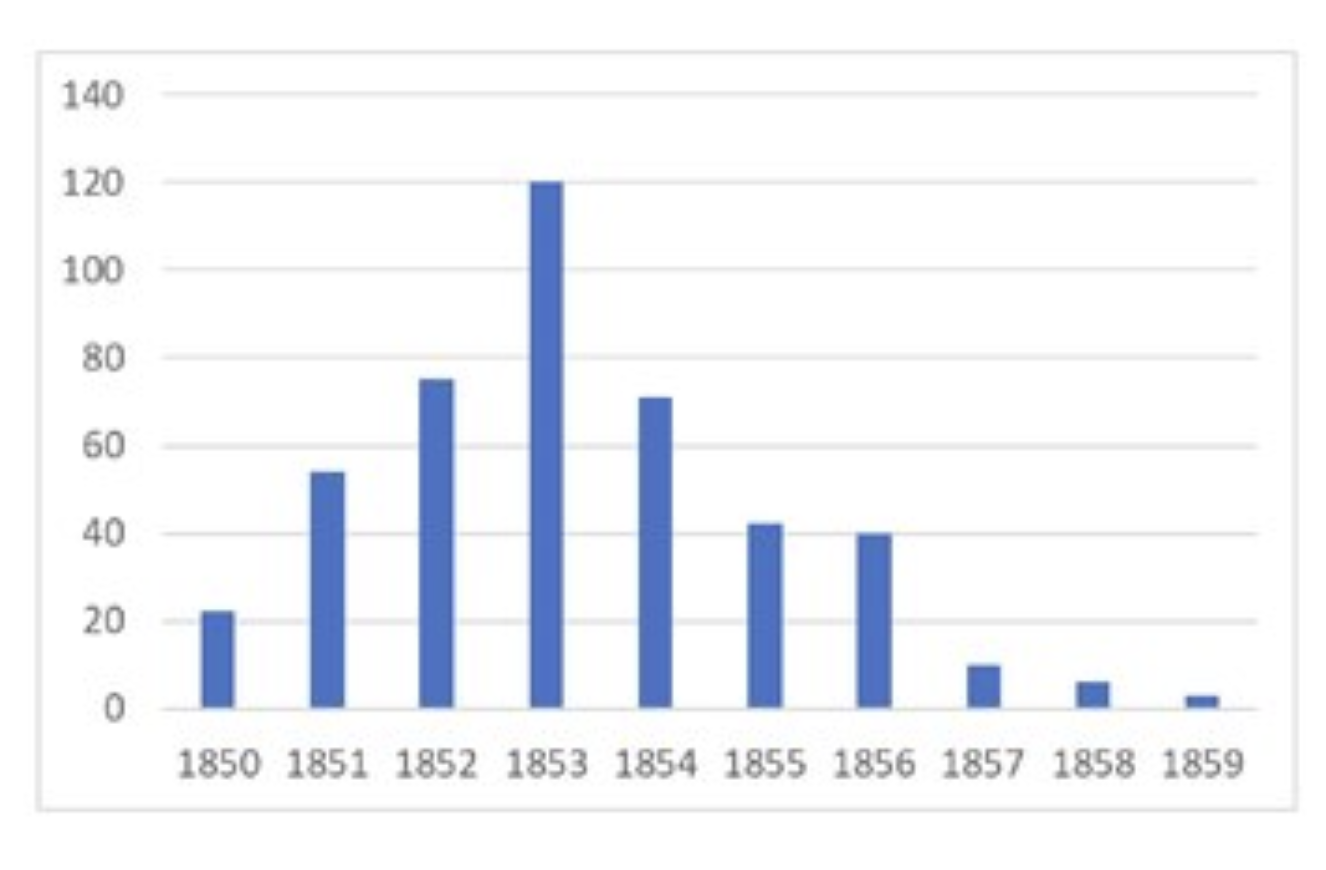
The captaincy of a clipper ship might be considered the zenith of seaman’s career because they were the largest cargo ships in use during the latter years of the age of sail- the 18th and 19th centuries. Preceding the predominance of clipper ships for passenger and cargo transport there were a variety of types of sailing vessels including brigs, barks, and schooners. Clipper ships did not completely replace such ships but became a dominant means of transportation of goods and passengers, particularly for transoceanic purposes. The main asset of clipper ships compared to other sailing vessels of the period was speed, a factor particularly valuable for transoceanic runs.
The graphic shows not only the rise but the decline in clipper ship production. Throughout this period and extending to the end of the century, there was a corresponding rise in the development and production of steam-powered vessels.
Within the scope of this brief, it is neither possible nor necessary to provide a comprehensive history of clipper ships- their origin, design, construction, utilization, and decline. A number of books have been published on this subject. Selected references are provided in the list of sources at the end of this brief. However, some explanation is needed to fully understand the content of the brief. According to historical accounts, the clipper ship was not the “invention of a master designer” who conceived a total new concept, but the result of an evolutionary process stretched out over a number of years if not decades. Here is the somewhat flowery manner in which Helen La Grange characterized the development and decline of clipper ships in her 1936 book, Clipper Ships of America and Great Britian, 1833-1869, that included illustrations by Jacques La Grange.
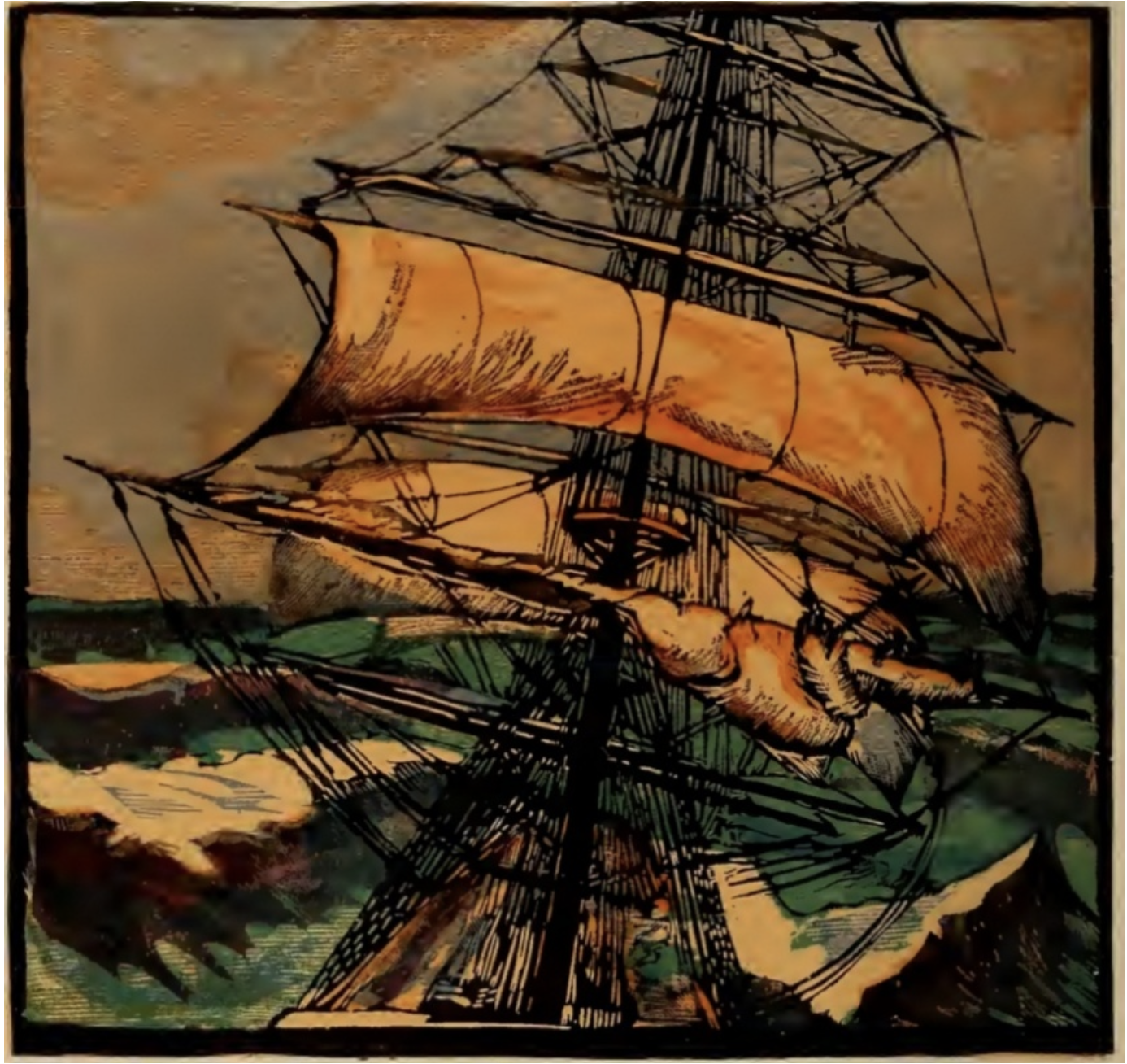
“The Rainbow is acknowledged to be the first extreme clipper to sail the seas, but none of the distinguished recorders of clipper-ship history contends that she emerged complete in every detail and innovation from the mind on one man , or in one day. Instead, her growth was like the slow blossoming of a flower, nursed into existence and beauty from a seed planted by unknown hands in the fertile soil of American imagination back in some earlier time. To say that the seed was watered by the tears of oppression, that the soil was plowed by the fingers of rebellion, and that the clipper-ship was the complete and final expression of an urge for equality, attended by the growing pains of a desire to show superiority, is to give you at once its flower and the germ of its decay.”
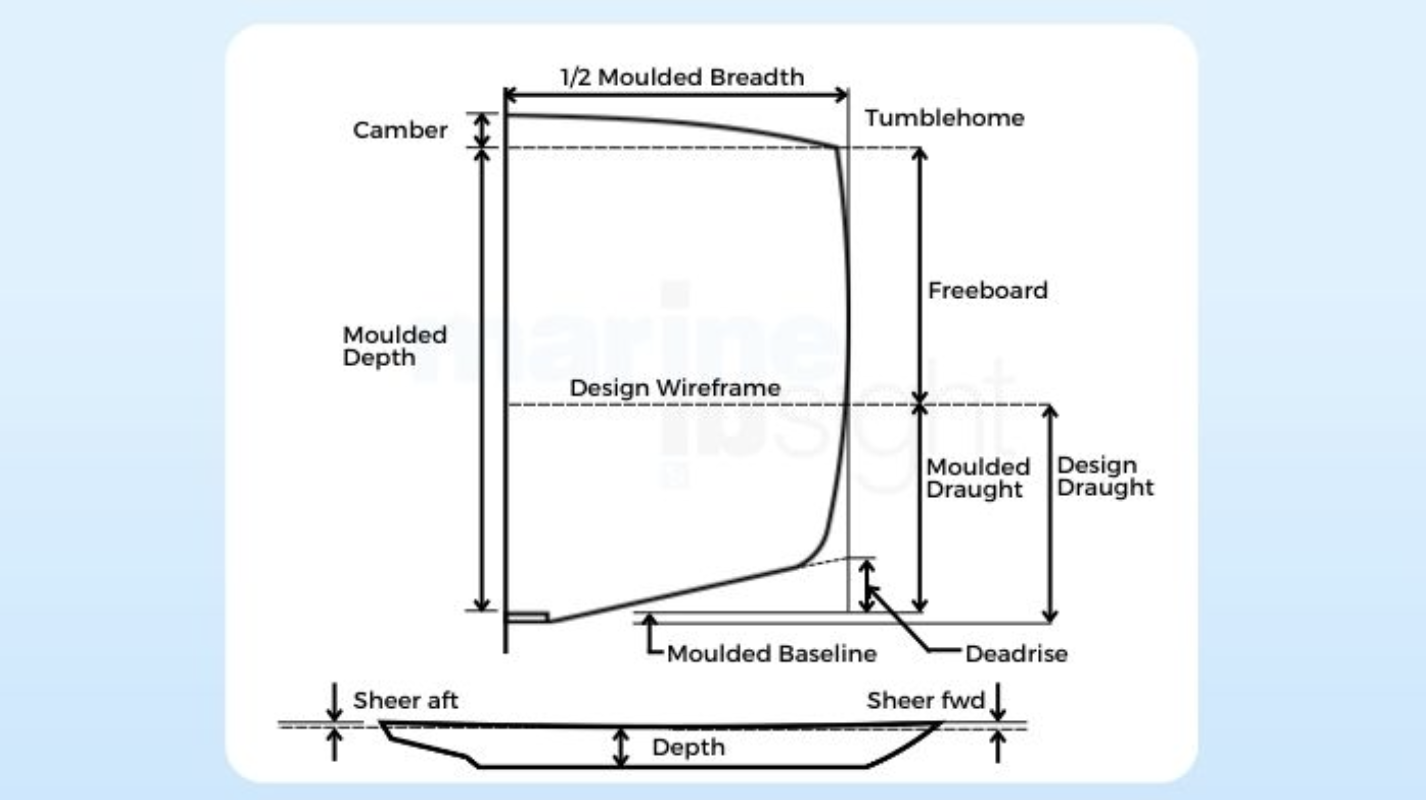
Clipper ships were classified as either “medium” or “extreme” clipper ships based on the shape of their hulls and certain design parameters, particularly dead rise at half floor (midpoint of the ship’s length). Medium clippers generally caried either 18 or 30 inches of dead rise at half floor whereas extreme clippers carried 40 inches at half floor. Depending on the reference, the Reporter was referred to as either a “medium” or “extreme” clipper ship but would actually qualify as a medium clipper based on the manner in which Howe and Matthews (1967) described the Reporter.
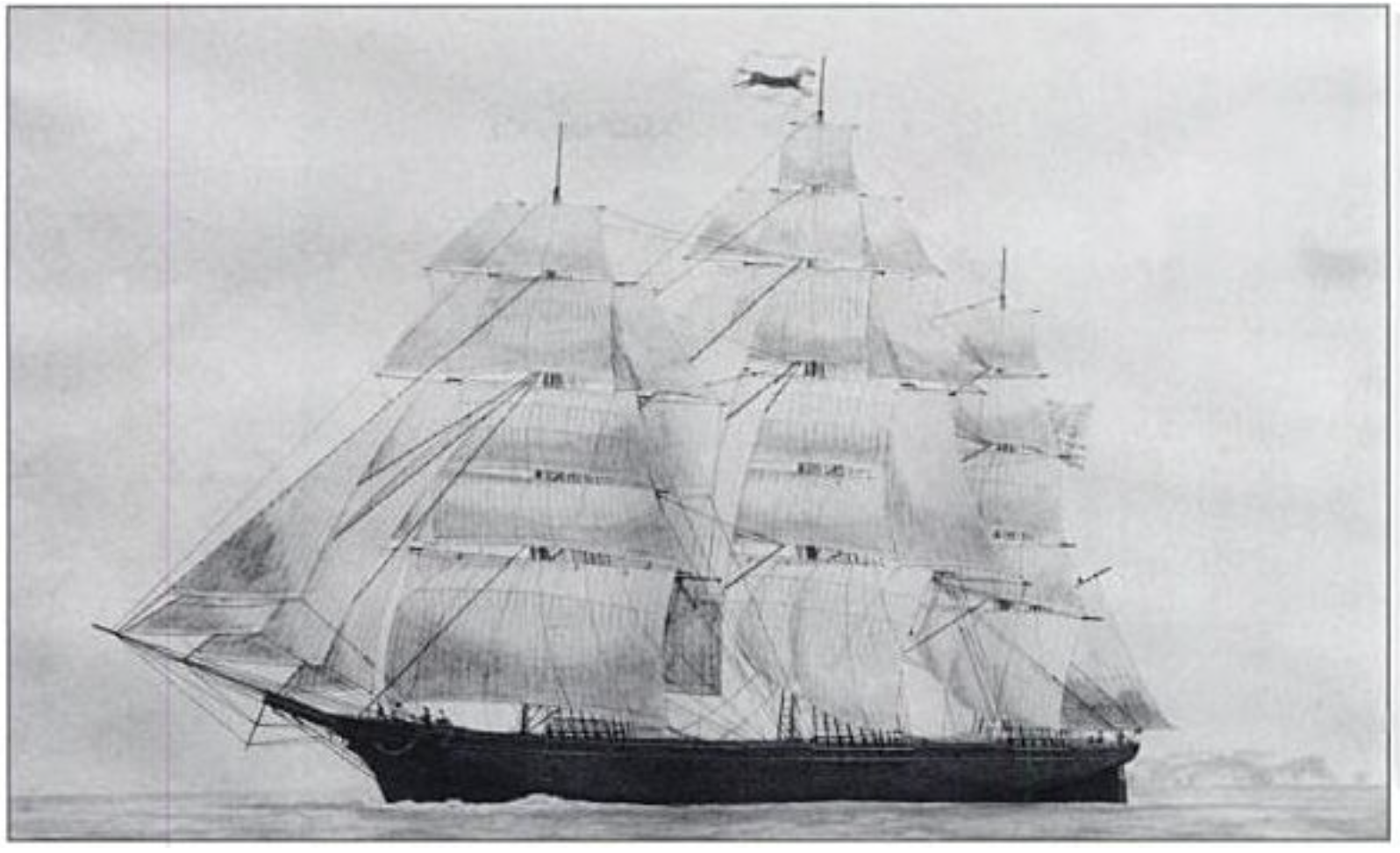
“In model, the Reporter was somewhat sharper than the general run of medium clippers and she has 18 inches of dead rise at the half floor. She was narrow for her length, her dimensions being: length of deck- 207.5 ft; beam- 39 ft; depth of hold- 24.6 ft; tonnage- 1474 tons American old style; 1431 tons by British measurement.”
“Cost of construction was $80,750 (Note: $3.33 million in 2025 dollars). For figurehead she carried a full-length representation of a reporter taking notes, but was not considered very artistic and one critic wrote “It looks like Colonel Green of the Boston Globe before he lost his hair and got religion.””
Extreme clipper ships, although the faster of the two classes of clipper ships, suffered from less cargo capacity and less stability compared to the medium clipper ship. Given that, starting in 1851 medium clipper ships began to be built and soon dominated clipper ship construction. Extreme clipper ship construction effectively ended in 1854. Clipper ships, particularly extreme clipper ships, were principally employed in the trans-Atlantic and trans-Pacific trades because of their speed.
The Reporter, launched in 1853, was built in the yard of Paul Curtis in East Boston, MA, under the supervision of Captain Octavius Howe who owned a one-eighth share in the ship and was to become her first captain. Among the prominent investors in the ship was David Snow of Boston, a General Commission Merchant at Constitution Wharf. According to encyclopedia.com: “The factor or commission merchant was one of the significant figures in the early commercial life of the country. These merchants were responsible for all facets of exchange and took responsibility for transporting and disposing of goods themselves, as well as providing credit to their customers.”
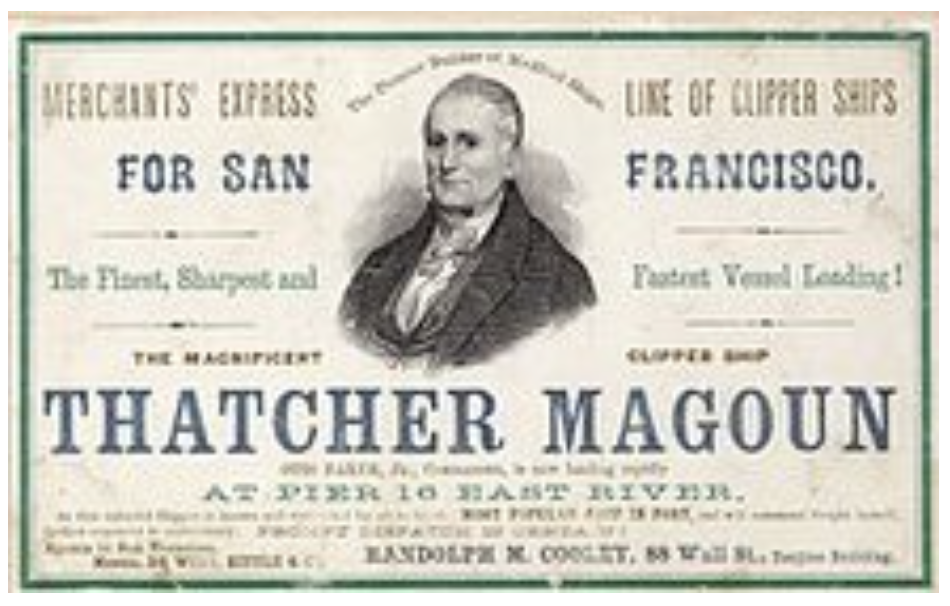
Paul Curtis and the Paul Curtis shipyard were prominent players in the clipper ship industry during the 19th Century. Born in 1800, Curtis moved to Medford, MA, at the age of 18 to begin his apprenticeship as a shipwright at the shipyard of Thatcher Margoun. Sixteen years later in 1834, he formed a company in partnership with James O. Curtis, of the same name but not related, that took over the Margoun Shipyard in 1836. The company built nine ships in the period 1834-1839 at which time the partnership dissolved. Acting alone, Paul Curtis continued to build boats in Medford, a total of 27 vessels, before moving to East Boston in 1852. The last recorded ship to be built by Curtis in his East Boston shipyard was the medium clipper ship Belvidere in 1857. Curtis died in 1873 at the age of 73.
Under the command of Captain Octavius Howe, the Reporter left on her maiden voyage to New Orleans on October 13, 1853, making the run in 15 days. It is unclear what her cargo was, but it was likely ice. The distance from the Port of Boston to the Port of New Orleans is 2209 nautical miles (2542 statute miles). A second source listed the distance as 1944 nautical miles. Assuming the distance to be 2209 nautical miles would require an average speed of approximately 6 knots (a knot is 1.15 mph) to make the voyage in 15 days. It is very unlikely that the Reporter was able to average 6 knots over the approximately 100 nautical miles from the entrance to Southwest Pass to the Port of New Orleans. In fact, there is evidence that she was delayed in crossing the bar. Given the two-day period documented in the ship’s log to cross the bar and assuming at least another day to negotiate the upriver leg with tug assistance to reach the Port of New Orleans, the average speed of the Reporter from the Port of Boston to the entrance to Southwest Pass would have likely been closer to 7.7 knots. An indication of the Reporter’s dependence on tugs to negotiate the bar and the river are the reported towage charges in and out of the river of $766 and $525, respectively. Each of these charges would have exceeded $20,000 in terms of 2025 dollars. Unfortunately, to date, I haven’t been able to locate any specific information about 19th Century tugboat design and operation in the Mississippi River. We do know that tugboats would have been steam powered and likely equipped with either side paddles or a screw propeller. The latter were first introduced in the United States in 1840.
While still under the command of Captain Howe, the Reporter was able to secure a cargo of 3000 barrels of flour, 6000 staves (possibly for the fabrication of barrels), and 3999 bales of cotton at the Port of New Orleans to be delivered to Liverpool, England. Leaving the Port of New Orleans on December 10th, she arrived at the Port of Liverpool on January 9, 1854, a total distance of 4586 nautical miles in 30 days. The total inclusive travel time of 30 days was the fastest passage at that time. Her average speed would have been approximately 6.4 knots. She returned to Boston loaded with salt in addition to cabin and steerage passengers. Once back in Boston, she was chartered to take a cargo of ice to New Orleans, a trip that required a total of 21 days including three days at the bar with four tugs working to get her across. Having discharged her cargo of ice, she secured another cargo of cotton bales and returned to Liverpool, a voyage during which she experienced a damaging lightning strike on the fore royalmast and light winds in the English Channel both of which delayed her arrival. Subsequent voyages under the command of Captain Howe, included but were not limited to:
A 27-day voyage from Liverpool to Boston with a full cargo and 371 passengers. Lacking cabins for most of the passengers, these passengers likely travelled in “steerage” (below decks near the ship’s cargo hold- generally cramped and unsanitary conditions).
A return to New Orleans at which Howe secured a cargo of 3768 bales of cotton and returned to Liverpool.
Returning from Liverpool, the Reporter arrived at the Port of Mobile in 42 days- a very slow passage!
A cargo of cotton was secured at Mobile and transported to Liverpool in 34 days.
Upon unloading her cargo, she returned to Boston with 382 passengers that represented her last trans-Atlantic crossing.
According to one source, the Reporter was “originally built for the cotton trade between New Orleans to England.” This same source concluded that “it was not profitable in the southern cotton trade on account of its size,” thus she was offered for sale in November 1855. She was purchased by W. F. Weld & Company of New York to be employed in the Cape Horn route to San Francisco and destinations in the western Pacific Ocean. Now under the command of Captain Howes (likely William Frederick Howes), the Reporter sailed from New York on December 10, 1855, for San Francisco, a voyage of some 107 days. From there, she sailed west to Manila in the Philippines, a voyage of 58 days. Returning to Boston from Manila, she then completed a number of voyages between the New York, San Francisco and Manila and New York, Liverpool and France. In 1860, a Captain Holt commanded the Reporter on a voyage from New York to San Francisco and return to Hampton Roads.
May 5, 1861, found the Reporter arriving at San Francisco after a 107-day run from New York under the command of Captain Howes. That was her last passage from New York to San Francisco and the last time that Captain Howes commanded the ship.
On June 3, 1862, the Reporter left New York bound for San Francisco under the command of Captain William H. White. Off Cape Horn on August 16th, a severe gale damaged the ship causing her to begin leaking. The following day, a tremendous sea further weakened the hull and demolished all the lifeboats effectively diminishing the hope of saving the ship and its crew. Not giving up, the ship was abandoned by the crew on two hastily constructed rafts. The occupants of one of the rafts were picked up by the British bark Enchantress but only four of its occupants were alive. Saved were William Townes, the second mate; William Bacon, steward; Charles Steele, seaman; and George Miller, seaman. The second raft was never located. A total of 32 officers and seamen lost their lives in the tragedy.
The second part of this brief will focus on the life and career of Captain Octavis Howe.
Sources
La Grange, Helen. Clipper Ships of America and Great Britian, 1833-1869, G. P. Putnam’s Sons, New York, 1936. (Illustrations by Jacques La Grange)
Howe, Octavius T. and Matthews, Frederick C. American Clipper Ships, 1833-1858, Volumes I and II, Argosy Antiquarian Ltd., New York, 1967.
Chapelle, Howard I. The History of American Sailing Ships, Bonanza Books, New York, 1935.
Chapelle, Howard I. The National Watercraft Collection, United States Government Printing Office, 1960.
https://en.wikipedia.org/wiki/Paul_Curtis_(shipbuilder)
chrome-extension://efaidnbmnnnibpcajpcglclefindmkaj/https://www.curtis-curtiss.org/document_view.asp?id=127
https://en.wikipedia.org/wiki/Clipper
https://www.museum.state.il.us/RiverWeb/landings/Ambot/Archives/stevens/screw.htm
