Henry Miller Shreve - A Mississippi River Master
The three previous briefs focused on major early Mississippi River explorers and investigators. While not necessarily an explorer or investigator, Henry Shreve played an important role in the early navigation of the river and the role of the river as a major commercial pathway connecting a large portion of the country.
At his induction to the Mississippi River Hall of Fame of the National Mississippi River Museum & Aquarium, Dubuque County Historical Society, Shreve’s contributions were characterized in the following manner:
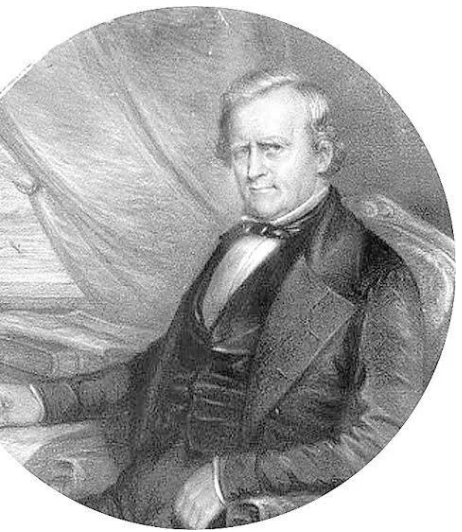
“Henry Miller Shreve, the master of the Mississippi and Superintendent of Western River Improvement from 1827-1841, was responsible for a long list of notable accomplishments including the first steamboat to travel down the Ohio and Mississippi rivers to New Orleans and back. He successfully broke the hold of the Fulton-Livingston claim to exclusive navigation on the Western rivers, and he brought the first keelboat from the Ohio to St. Louis and north up the Mississippi all the way to the Fever River. He pioneered a number of technical innovations on early steamboats, including horizontal cylinders, multiple separate boilers, machinery to allow the steamboat’s paddlewheels to work independently, multiple decks and the prototype for showboats.”
Shreve was born at Burlington County New Jersey in 1785, the son of Israel Shreve, a Quaker farmer who served as a colonel in the American Revolution during the period, 1775- 1781. In 1788, Israel Shreve led his wife, six children and 21 other settlers to Fayette County, Pennsylvania. They settled on land owned by George Washington and negotiated with Washington to lease the land. From January to June 1789, Shreve accompanied retired Continental Army Colonel George Morgan to survey Spanish Louisiana Territory on the west bank of the Mississippi River. One of the outcomes of the expedition was the establishment of a town, New Madrid. Later, Shreve entered into a protracted and contentious series of negotiations with Washington to purchase 1,744 acres of land but as of late 1798 had yet to conclude the sale. Shreve’s father died December 14, 1799, the same day Washington died.
The fact that the Shreve family settled near the Youghiogheny River and the Borough of Perryopolis probably led Henry Shreve to work on keel boats and barges operating on the Monongahela and Ohio Rivers as a means to help support his family. There is no evidence that Shreve received a formal education but was reported to have been home schooled.
As of 1807, Shreve had acquired the rank of captain which allowed him to pilot vessels along the Mississippi River and its tributaries. His initial venture was to build a barge of 35 tons at the Borough of Brownsville in Fayette County Pennsylvania that he manned with a crew of 10 men and operated along the Monongahela, Ohio and Mississippi Rivers between Pittsburgh and St. Louis. During the period, 1810-1814, Shreve was engaged in lead trade. His efforts on the Upper Mississippi River proved to be very profitable during the initial year of operation. At the end of 1810, Shreve abandoned his trade in the Upper Mississippi area, returned to Brownsville and built a barge of 95 tons. Upon completion of the barge, he began operating between New Orleans and Pittsburgh. On one trip out of New Orleans, Shreve and his crew “poled and hauled” a cargo-ladened barge some 2,200 miles to Brownsville, Pennsylvania against strong currents. The voyage required as many as 5 months to complete!
In late 1814, Shreve was assigned command of the Enterprise, a steamboat with an engine and power train designed by Daniel French who had received a patent for his steam engine in 1809 that became the standard on western steamboats. The vessel was built in Brownsville for the Monongahela and Ohio Steam Boat Company during the period. Fall 1813- May 1814.
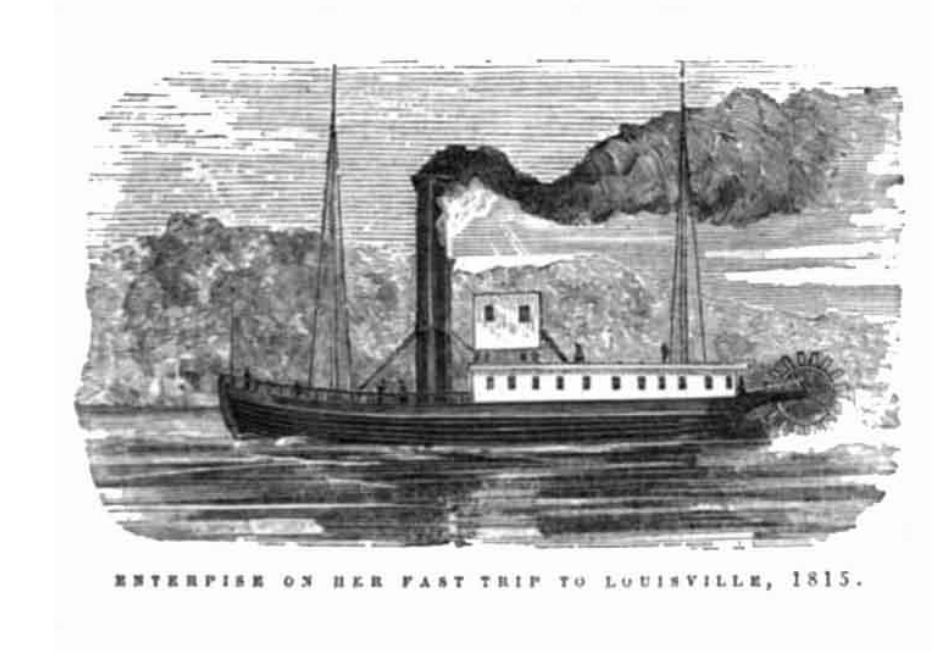
After her launching, the Enterprise made two successful voyages with passengers and cargoes between Brownsville and Louisville, Kentucky, under the command of Israel Gregg. In December of 1814, a decision was made to send a cargo of munitions to General Andrew Jackson to repel the British forces at New Orleans. Because of his extensive knowledge and experience in navigating the Ohio River and the Lower Mississippi River, the command of the Enterprise was transferred from Gregg to Shreve. With Shreve in command, the Enterprise departed from Pittsburgh on December 21, 1814, and arrived in New Orleans on January 9, 1815, one day after the Battle of New Orleans.
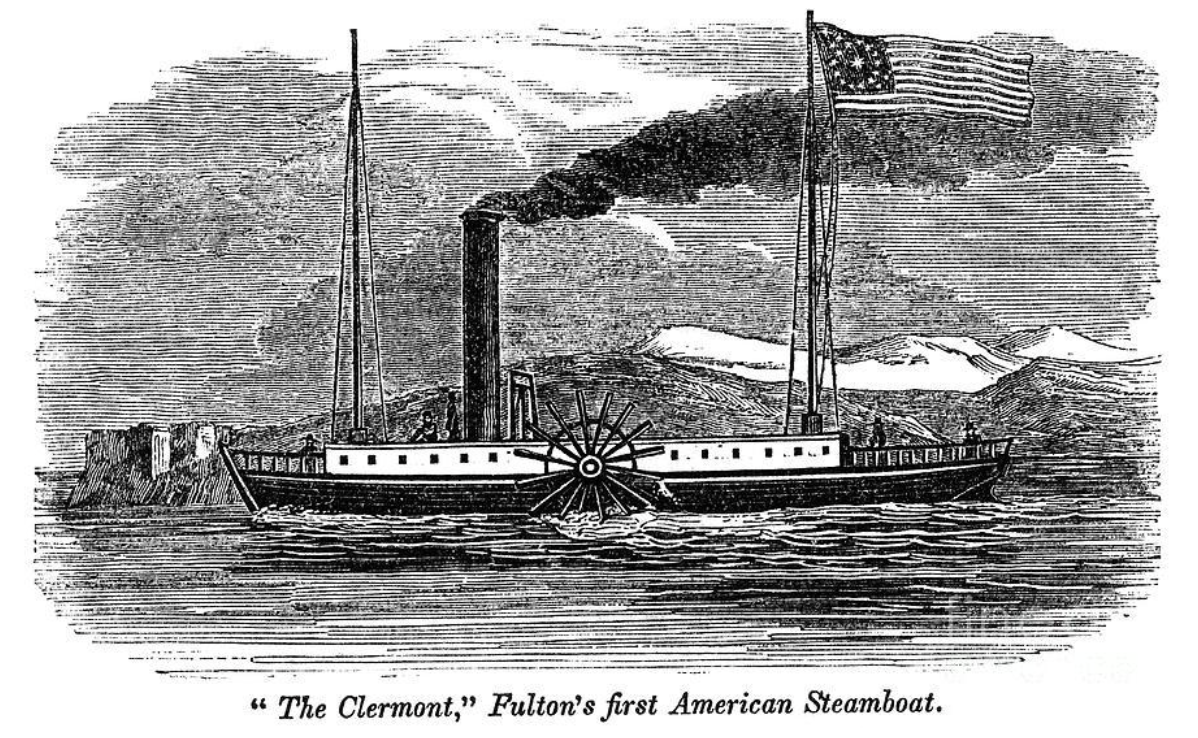
The voyage of the Enterprise brought about another battle, this time between the heirs of the Robert Fulton and Robert Livingston and the Monongahela and Ohio River Steam Boat Company, including Shreve, for violation of the Fulton-Livingston combine’s monopoly on steamboat operation on the Mississippi River. Earlier, based on the performance of their steamboat the North River (commonly referred to as the Clermont), the combine had been awarded a monopoly for operating in New York waters. Based on that success and as described below, the Combine later secured a similar monopoly for steamboat operation on the Mississippi River.
While serving as the US Minister to France, Livingston was instrumental in facilitating the Louisiana Purchase from France in 1803, so with the help of his brother, was able to secure a monopoly for operating steamboats on the Mississippi River once the Louisiana Territory became a state in 1812. The Fulton-Livingston collaboration was the first organization to introduce steamboat operation on the Mississippi River by a voyage from Pittsburgh, Pa, to New Orleans, La, with their new completed steamboat, New Orleans. The voyage began on October 20, 1811, after a trial trip around Pittsburgh on October 15th. While shown in the lithograph as a stern wheeler, it has generally been established that she was actually a side wheeler.
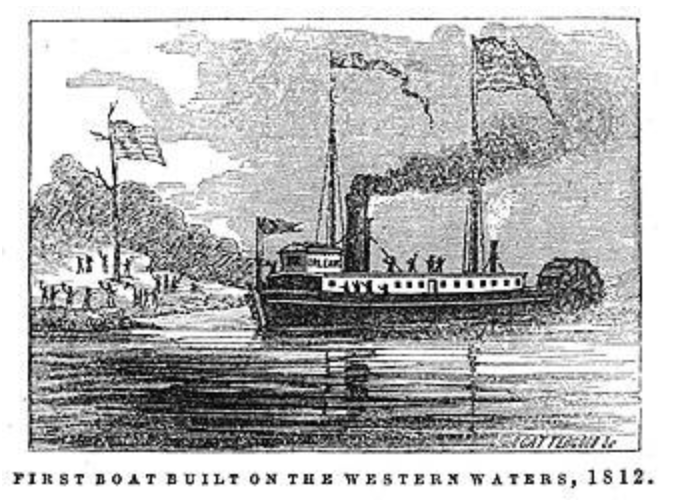
In advance of initiating the October 20 voyage, the Fulton-Livingston collaboration sent Nicholas Roosevelt, a producer of copper and manufacturer of steam engines, on a mission to explore, survey, and test the waters of the Mississippi River. Lasting slightly over 6 months, during which Roosevelt measured depths and currents along the river, the expedition resulted in a favorable report of river conditions. Because of his newfound knowledge of the rivers, Roosevelt was assigned to captain the New Orleans. While captaining the New Orleans on her first Pittsburgh to New Orleans voyage, Roosevelt waited a month at Louisville for the waters to rise and provide an adequate depth for her safe passage. The voyage was accompanied by a series of substantial events that could have been but were not catastrophic: appearance of native American warriors, luckily not hostile; an onboard fire that was quickly extinguished; and an earthquake- the New Madrid Earthquake of 1811 that had little to no impact on the steamboat, its passengers and cargo.
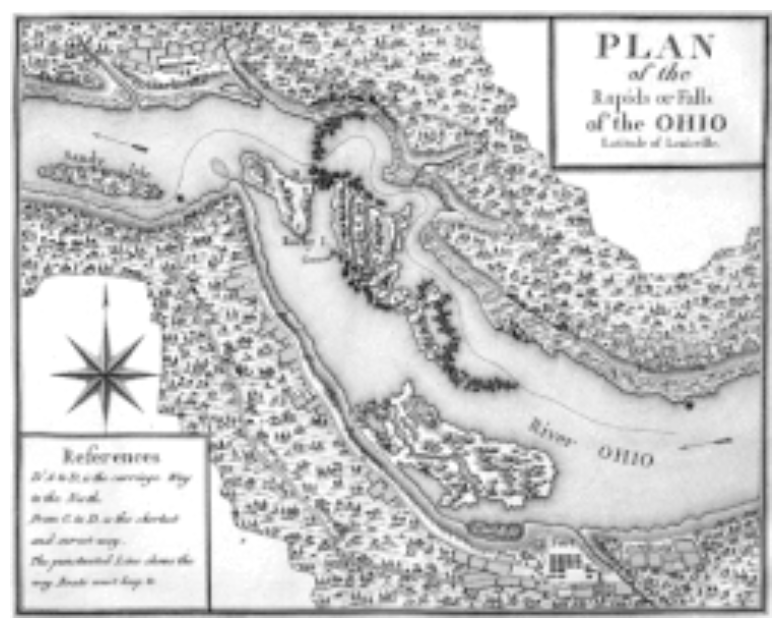
In establishing a permanent route between Pittsburgh and New Orleans, the Fulton-Livingston collaboration decided to divide the route between Pittsburgh and New Orleans into two sections- Pittsburgh to and from Louisville and Louisville to and from New Orleans. This decision was made because of the difficulty in navigating the “Falls of the Ohio”. The falls area of the Ohio River at Louisville is characterized by fossil beds resulting in areas of shallow water making steamboat navigation hazardous.

Despite the Fulton-Livingston monopoly, starting in 1816 Shreve was captaining a new David French-designed steamboat, the Washington. Built in Wheeling, Virginia (now West Virginia) by George White, the Washington was the first steamboat with two decks, had a particularly shallow draft, and became the standard for the design of future steamboats.
Here is an account of the initial voyage of the Washington: “The Washington was launched and set sail for New Orleans June 3, 1816. Her sixth day out, near Marietta, Ohio, the end of one of her engine’s cylinders was blown off. A column of scalding water was thrown among the crowd, inflicting injuries on nearly all of the boat’s crew and passengers. Seven were killed outright and seven were wounded by inhaling the scalding steam. Several of the wounded died a short time afterwards.” The Washington, soon repaired and newly provisioned, got underway September 9th. She arrived at Louisville on September 20th and reached New Orleans on October 7, 1816. Shreve made two successful trips to Louisville and back to New Orleans and on her third, she made Louisville in 24 days.” Shreve was reported to have sustained minor injuries despite having been blown off of the vessel, only to be recovered along with other members of his crew.
Early in 1817, Shreve piloted the Washington to New Orleans where he was reportedly jailed temporarily for violating the Fulton- Livingston monopoly. According to American Heritage… “Finally caught, he won the case when the court ruled that the territory had no authority to grant a monopoly. By this time Fulton and Livingston were both dead, and their heirs did not pursue the case in a higher court. The Mississippi was free.” American Heritage further wrote: “Freight out of New Orleans increased from 65,000 tons in 1810 to 4,690,000 in 1860. As early as 1841, a Westerner could write: “Steam navigation colonized the West! … Steam is crowding our eastern cities with western flour and western merchants, and loading the western steamboats with eastern emigrants and eastern merchandise. It has advanced the career of national colonization and national production at least a century.”
I found essentially no information concerning Shreve’s activities subsequent to 1817 until he was appointed the Superintendent of Western River Improvements on December 1, 1826. Presumably, Shreve continued to captain steamboats between Pittsburgh and New Orleans during that period. His appointment was motivated by the need for someone to deal with the snags and logjams in the western rivers. Shreve reportedly had been working on the design of what was termed a snagboat since 1821. As described in Wikipedia (Snagboat - Wikipedia: “A snagboat is a river boat, resembling a barge with superstructure for crew accommodations, and deck-mounted cranes and hoists for removing snags and other obstructions from rivers and other shallow waterways.” Resulting from Shreve’s efforts and under his direction, the first twin steam snagboat, the Heliopolis, was built. Unfortunately, I could not locate any photos or diagrams of the Heliopolis.
In advance of employing the Heliopolis to remove major snags and logjams in the waterways, Shreve conducted trials at Plum Point on the Mississippi River on August 25, 1826. He reported that the trials were a great success. Given that, in 1832, Shreve was ordered by the Secretary of War Lewis Cass to clear the “Great Raft” on the Red River. According to Wikipedia (Great Raft - Wikipedia). “The Great Raft was an enormous log jam or series of rafts that covered the Red and Atchafalaya rivers in North America from perhaps the 12th century until its destruction in the 1830s.” The raft was reported to have covered over 150 miles and was somewhat concentrated near what today is his namesake city of Shreveport that was established March 20, 1839. Under Shreve’s direction, the raft was successfully cleared as of 1839. Somewhat negative outcomes resulted from Shreve cutting channel through river bends resulting in shallows at the entrances of the Atchafalaya, Red, and Ouachita rivers.
Little is written about Shreve, his life and activities, subsequent to 1839. It is presumed that he continued to operate snagboats and clear waterways until retirement. He passed away March 6, 1851, at the home of his son-in-law in St. Louis, MO.
Shreve led a consequential and productive life, making extremely significant contributions to the navigation and commerce of the western rivers, particularly the Mississippi River.
Sources
https://en.wikipedia.org/wiki/Henry_Miller_Shreve#The_Washington,_1816
https://en.wikipedia.org/wiki/Great_Raft
https://www.americanheritage.com/steamboat-monopoly
https://en.wikipedia.org/wiki/North_River_Steamboat
https://en.wikipedia.org/wiki/Israel_Shreve
